Harrier and Sea Harrier  9788076481282
Harrier and Sea Harrier  9788076481282Harrier and Sea Harrier  9788076481282Harrier and Sea Harrier  9788076481282Harrier and Sea Harrier  9788076481282Harrier and Sea Harrier  9788076481282Harrier and Sea Harrier  9788076481282

Harrier and Sea Harrier

Product code 9788076481282

€ 10.05

:
Add to cart

Series Aero 126

Publisher/Brand Jiri Jakab

Author Jakub Foijtik

Format a4

No. Pages 52

Version Soft cover

Language Czech

Category Aviationbooks

Subcategory UK » UK Aircraft/Heli

Availability only 1 remaining

Add this product to my wishlist

This product was added to our database on Thursday 25 September 2025.

Your reliable Aviation Book Source since 1989


Also in this series:
ProductPublisher/BrandSeries/scalePrice €
B-25 Mitchell v SSSR a Tupolev SB (B-25 Mitchell in the USSR and Tupolev SB) JAK-A034B-25 Mitchell v SSSR a Tupolev SB (B-25 Mitchell in the USSR and Tupolev SB)Jiri JakabAero 34€ 7.29
Dakota a Lícko, Douglas C47 a Lisunov Li-2 2.díl / C47 and Li2 in Czechoslovak service part 2 JAK-A054Dakota a Lícko, Douglas C47 a Lisunov Li-2 2.díl / C47 and Li2 in Czechoslovak service part 2Jiri JakabAero 54€ 7.29
Eurofighter Typhoon JAK-A121Eurofighter TyphoonJiri JakabAero 121€ 10.05
Hawker Hurricane v SSSR/ Aero A-29 a Letov S-328v - Letadla pro Kumbor JAK-A037Hawker Hurricane v SSSR/ Aero A-29 a Letov S-328v - Letadla pro KumborJiri JakabAero 37€ 5.46
Lockheed Martin F-35 Lightning II JAK-A96Lockheed Martin F-35 Lightning IIJiri JakabAero 96€ 10.05
McDonnell Douglas/Boeing F-15 Eagle JAK-A112McDonnell Douglas/Boeing F-15 EagleJiri JakabAero 112€ 9.13
MiG-15UTI v Cs. vojenském letectvu  / MiG15Uti in Czechoslovak Air force service JAK-A102MiG-15UTI v Cs. vojenském letectvu / MiG15Uti in Czechoslovak Air force serviceJiri JakabAero 102€ 10.05
MiG-21U,US,UM v cs. a Ceském letectvu 1.díl / MiG-21U,US,UM in Czechoslovak Service  Part 1 JAK-A075MiG-21U,US,UM v cs. a Ceském letectvu 1.díl / MiG-21U,US,UM in Czechoslovak Service Part 1Jiri JakabAero 75€ 8.21
Padesát roku L410 / 50 years of L410 JAK-A055Padesát roku L410 / 50 years of L410Temporarily Out of Stock.Jiri JakabAero 55€ 7.29
Stalinovi sokoli táhnou na západ,Utok Sovetsko Zvazu na polska 19 Zari 1939 / Stalin's falcons are moving west, Attack of the Soviet Union on Poland September 19, 1939 JAK-507Stalinovi sokoli táhnou na západ,Utok Sovetsko Zvazu na polska 19 Zari 1939 / Stalin's falcons are moving west, Attack of the Soviet Union on Poland September 19, 1939Temporarily Out of Stock.Jiri JakabAero Special 7€ 10.05

Product description

T

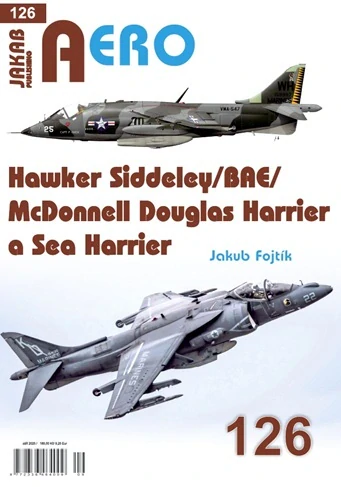
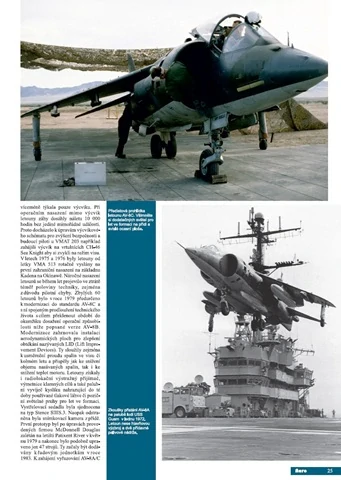
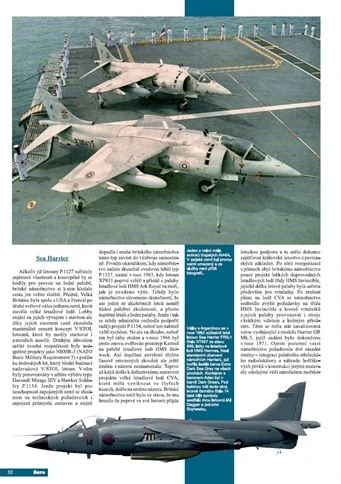
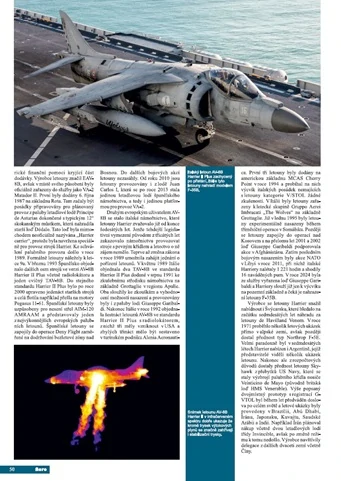
The Harrier multi-role aircraft and its second generation Harrier II were created as a response to Western countries' concerns about the possible destruction of airport infrastructure by the Warsaw Pact air forces. Even less precise attacks could have made it impossible to deploy conventional aircraft, and this threat persists to this day. The ability to take off and land vertically rather than vertically was intended to allow the use of this type of technology practically anywhere. The emergence of the S/VTOL (Short/Vertial Take Off and Landing) aircraft in the UK was only possible thanks to the development of a revolutionary power unit for its time - the Pegasus turbofan engine. It came up with the concept of extracting compressed air from the compressor and, thanks to two nozzles of this "cold" air and two nozzles directing hot exhaust gases, it was the first to manage the development of a similar device. This is also one of the reasons why the Harrier was successful, while the Soviet Yak-38/38M aircraft had only limited service. The additional lifting engines of the Soviet model turned out to be bulky, heavy and fuel-intensive, so the performance of the Yak-38 was significantly behind the Harrier, which was conceptually a decade older. The Harrier aircraft is therefore among the most advanced assets created entirely under the direction of the British aviation industry. All subsequent aircraft were more or less cooperative international programs, where Great Britain was only one of the technological partners. Therefore, it is, together with the BAE Hawk aircraft, a certain symbol of the British aviation industry.  

Despite the successful mastery of the vertical take-off and landing concept, the Harrier models saw service with only a limited number of users, and their main operators were the armed forces of Great Britain and the United States of America. Very soon, the navy and marine corps became dominant, which greatly exceeded that of the air force, when the only conventional air force operating the aircraft was the British. All other users, whether it was India, Italy, Spain, Thailand or the United States, operated the aircraft with the naval air force or the marine corps. It is therefore somewhat surprising that only Great Britain decided to initially deploy it with the aim of ensuring operational capabilities even when destroying airfields, although several other countries initially expressed interest in the aircraft. The reason for this was both the limited flight envelope of the machine, which did not allow for highly supersonic flights, and its worse parameters compared to multi-role types. The fact that it was a British, and not a pan-European product, which was competing for the same market as international Eurofighter aircraft, did not go unnoticed. Another reason for the smaller expansion was the acquisition and operating cost, which significantly exceeded the costs of conventional multi-role aircraft of the time. Nevertheless, the Harrier and Harrier II aircraft clearly showed how effective the concept of an S/VTOL aircraft is. And the fact that a similar device is necessary is evidenced by the development of the F-35B version of the same category, which is the direct successor to the Harrier in all roles for several of its users. Today, it is approaching decommissioning from service with the last major user, the US Marine Corps, and the last aircraft will be seen in operation in Spain after the planned withdrawal from service in Italy. The British legend is therefore gradually disappearing from service. 

 The publication is A4 format, full-color on high-quality coated paper, V2 binding, 52 pages, many photos, color side views.