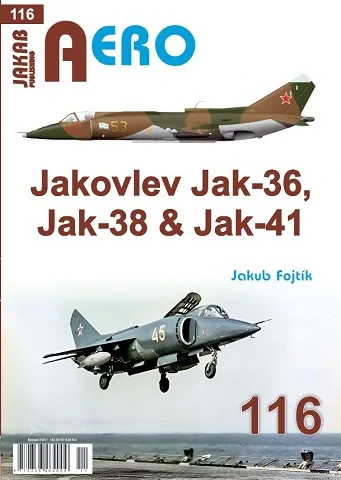
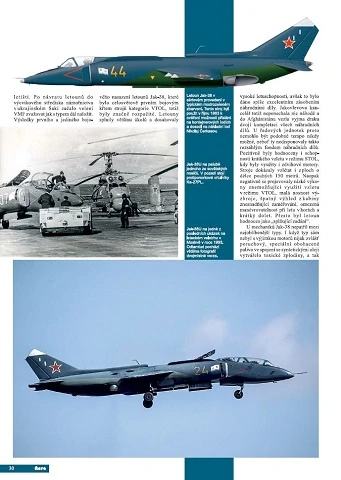
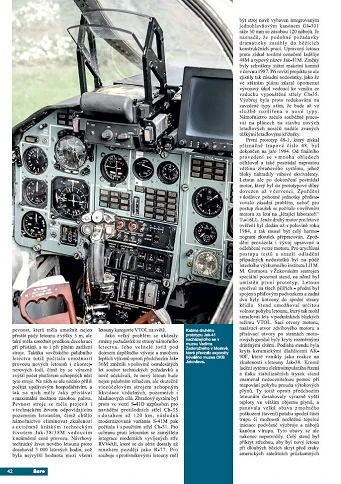
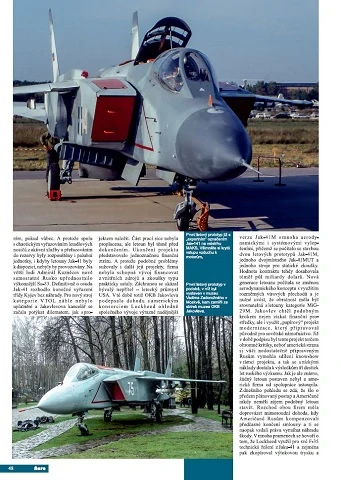
Jakovlev Jak-36, Jak-38 & Jak-41
Product code 9788076481060
Series Aero 116
Publisher/Brand Jiri Jakab
Author Jakub Fojtik
Format a4
No. Pages 52
Version Soft cover
Language Czech
Category Aviationbooks
Subcategory Eastern Europe » Soviet Jet Aircraft
Availability only 2 remaining
This product was added to our database on Thursday 21 November 2024.
Your reliable Aviation Book Source since 1989
Also in this series:
| Product | Publisher/Brand | Series/scale | Price | ||
|---|---|---|---|---|---|
 | B-25 Mitchell v SSSR a Tupolev SB (B-25 Mitchell in the USSR and Tupolev SB) | Jiri Jakab | Aero 34 | € 7.29 | |
 | Fotokronika letouny firmy Heinkel 1.díl / Photo Chronicle of Aircraft of the Heinkel firm part 1 | Jiri Jakab | Aero Special 6 | € 8.21 | |
 | General Dynamics / Lockheed Martin F16 Fighting Falcon Part 2 | Jiri Jakab | Aero 85 | € 9.13 | |
 | Grumman F4F-3 and F4F-3A Wildcat, | Jiri Jakab | Aero 128 | € 10.05 | |
 | Harrier and Sea Harrier | Jiri Jakab | Aero 126 | € 10.05 | |
 | Messerschmitt BF109E Dil 2 | Jiri Jakab | Aero 64 | € 7.29 | |
 | MiG-15UTI v Cs. vojenském letectvu / MiG15Uti in Czechoslovak Air force service | Jiri Jakab | Aero 102 | € 10.05 | |
| Spitfire MKIX 1.dl | Jiri Jakab | Aero 29 | € 5.46 | ||
 | Spitfire MKV 3.dl | Jiri Jakab | Aero 26 | € 5.46 | |
 | Wellington MK1 | Jiri Jakab | Aero 1/101 | € 7.29 |
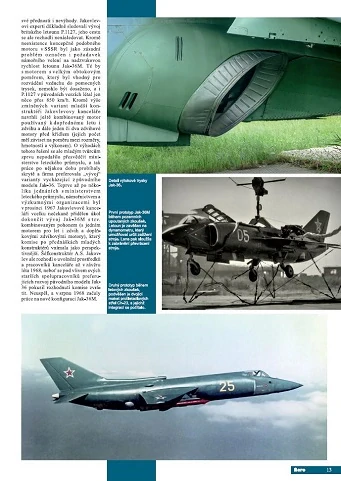
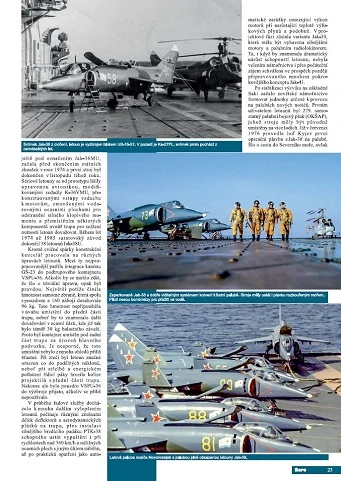
In the period of the ongoing Cold War and preparations for a conflict with the use of nuclear weapons, airborne aviation began to play a significant role. The American under the US Navy was able to concentrate considerable combat power in practically any place in the world, including the ability to carry out attacks with nuclear weapons. The long tradition of the American shipboard navy, dating back to the 1920s, as well as extensive deployment in the Second World War and in Vietnam, made it possible to refine combat procedures and fine-tune the performance of the machines used. It is therefore not surprising that for the military strategy of the USSR, American aircraft carriers represented one of the main threats. To match the capabilities of the Americans, the Soviet military industry did not have enough experience, and even the economy of the largest state in the world would not be able to finance the enormously expensive development of a numerically equivalent air force, including carriers, especially when there was an enormously expensive competition in the conquest of space or in the development of ballistic missiles or ambush fighters. That is also why requirements for aircraft with vertical take-off and landing began to gain importance in the USSR. These would enable deployment on structurally simpler and economically significantly cheaper ship carriers, and in the event of a crisis state of war, it should be possible to operate them from the decks of container and other ships as well. That is why the Yak-36 experimental machine project was created, which later enabled the creation of the Yak-38 serial model. Even after a quarter of a century since the end of its operation, the Yak-38 is still among the types about which relatively little is known. And this despite the fact that the service of this aircraft was not lacking in drama. For the USSR, it was one of the most complex development tasks, as a whole range of technical solutions used on the aircraft were developed purely for this type. Although the service of the Yak was accompanied by many extraordinary events, the knowledge gained helped the Soviet industry to master the development of technologies that were to be used in the next very promising Yak-41 model. The vertical take-off Yak-41 was a promising design that, if introduced into service, would finally allow the Soviet Naval Air Force to obtain a truly powerful machine surpassing in many respects the Western competition in the form of the Harrier type. The previous Yak-38 aircraft did not meet the requirements and represented more than limited combat power. But the chaos accompanying the collapse of the USSR intervened in the fate of the Yak-41, and one of the most promising aircraft in history ended its career without reaching regular service. Therefore, the USSR was never able to keep pace with the USA, and its airborne air force is still more of a demonstrative unit than a real fighting force capable of eliminating targets in the air, on the ground and on the surface anywhere in the world.