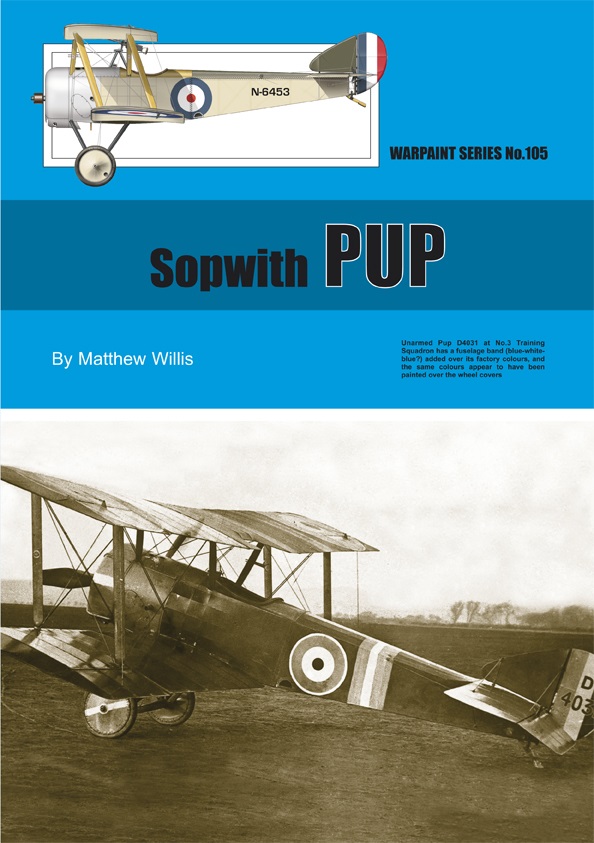
Sopwith Pup  ws-105

Sopwith Pup

Product code ws-105

Sopwith

€ 14.63

:
Add to cart

Series Warpaint Series No 105

Publisher/Brand Hall Park

Author Matthew Willis

Format a4

No. Pages 125

Version Soft cover

Language English

Category Aviationbooks

Subcategory World Wars Books » WW1

Availability only 1 remaining

Add this product to my wishlist

This product was added to our database on Wednesday 11 November 2015.

Your reliable Aviation Book Source since 1989


Also in this series:
ProductPublisher/BrandSeries/scalePrice €
Bristol Scout ws-128Bristol ScoutHall ParkWarpaint Series No 128€ 16.47
Consolidated B24 Liberator WS-96Consolidated B24 LiberatorHall ParkWarpaint Series No 96€ 29.31
Dassault Mystere & Super Mystere ws-148Dassault Mystere & Super MystereHall ParkWarpaint Series No 148€ 17.39
De Havilland DH 89 Dragon Rapide and Dominie De Havilland DH 89 Dragon Rapide and DominieHall ParkWarpaint Series No 135€ 20.14
Fairey Battle WS-83Fairey BattleHall ParkWarpaint Series No 83€ 15.55
Fairey Firefly F.Mk.1 to U.Mk.9 Fairey Firefly F.Mk.1 to U.Mk.9Hall ParkWarpaint Series No 28€ 17.39
Focke Wulf Fw200 Condor FW200 CONDORFocke Wulf Fw200 CondorTemporarily Out of Stock.Hall ParkWarpaint Series No 13€ 14.63
Hawker Hunter HUNTERHawker HunterHall ParkWarpaint Series No 8€ 17.39
Lockheed T33A Shooting Star WS-88Lockheed T33A Shooting StarHall ParkWarpaint Series No 88€ 15.55
McDonnell F101 Voodoo WS-47McDonnell F101 VoodooHall ParkWarpaint Series No 47€ 16.47

Product description

The Sopwith Pup, as it is unofficially but universally known, was one of the first true British fighter aircraft, and one of the most significant of the First World War. It played a key part in maintaining control of the skies over the Western Front during and after the RFC's toughest period, Bloody April, 1917. Its superb flying qualities kept it competitive as ever-faster and more powerful opposition appeared, and it played an unglamorous but important role in the defence of the UK against zeppelin and heavy bomber attacks, and was fundamental to the development of ship-based aviation. With the very well-established categories of military aircraft that are familiar today, it is hard to comprehend the world in which the Pup was born, where these clear delineations did not exist. Certainly the idea of the fast, agile single-seat fighter was barely thought of when the Pup's outline was first chalked on the floor of the experimental workshop at Sopwith's Kingston-upon-Thames premises in 1915. The new aircraft was known as the 'Sparrow', was powered by a 50hp Gnome rotary. Test pilot Harry Hawker took the aircraft to Brooklands and amazed trainee RFC pilots by flying it under the bridge across the Byfleet Banking. It was fully aerobatic and capable of a speed just shy of 85mph despite the low engine power. It is unclear whether Sopwith intended the machine to form the basis of a military aircraft but in any event, its performance and handling, even on such low power, must have recommended it for that purpose. The 'Sparrow' therefore became the progenitor of the aircraft that would become the 'Pup'. It was around the time of the prototype's first appearance that the Pup seems to have gained its popular name. Brigadier-General SeftonBrancker, then the RFC's Director of Air Organisation, is reputed to have remarked, on seeing the prototype Scout beside its larger sibling at Brooklands, 'Your 1½ Strutter has had a pup!' For all its value as a front line fighting aeroplane, the Pup had a potentially even greater impact on the development of naval aviation; in particular, the sometimes tortuous path of launching aircraft from, and returning them safely to, ships at sea. Moreover, the Pup became one of the more successful operational aircraft in this fledgling area of combat. This is the first WWI title in the series and includes all the usual Warpaint features – historical text, modellers glossary, colour artwork by Richard Caruana and a three page colour walkaround by author Matthew Willis.