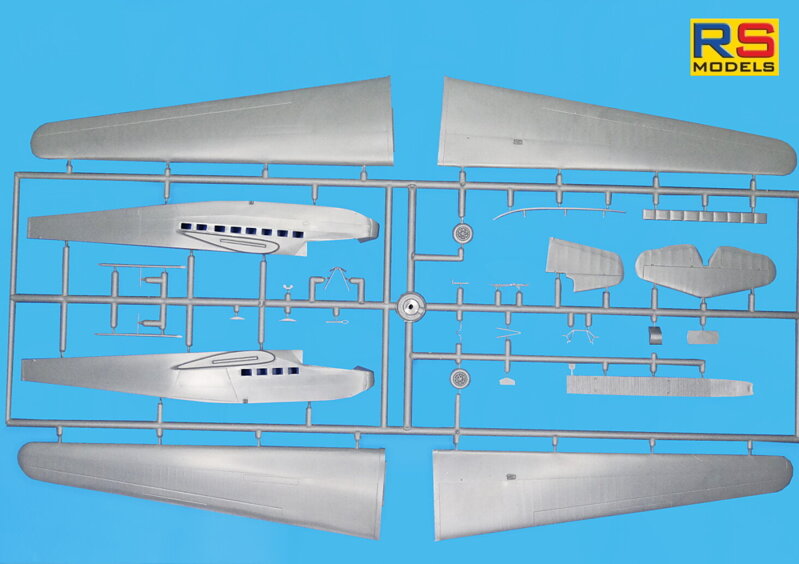
DFS230 (WWII Romania and Italy)
Product code 92314
Scale 1 : 72
Publisher/Brand RS Models
Category Scale Modelling Kits
Subcategory Scale Modelling Kits
Availability In stock
This product was added to our database on Tuesday 15 September 2026.
Your reliable Aircraft Modelling Source since 1989
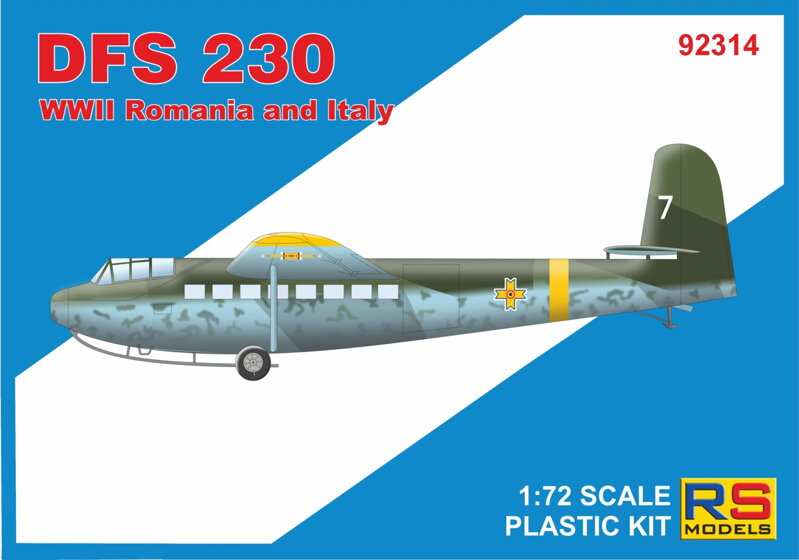
The DFS 230 was a German transport glider. It was developed in 1933 by the Deutsche Forschungsanstalt für Segelflug with Hans Jacobs as the head designer. In addition to the pilot, the DFS-230 glider had room for nine men who sat close together on a narrow bench located in the middle of the fuselage. Entry and exit to the cramped interior was by a single side door. The front passenger could operate its only armament, a machine gun. It was an assault glider, designed to land directly on top of its target, so it was equipped with a parachute brake. This allowed the glider to approach its target in a dive at an angle of eighty degrees and land within 20 metres of its target. It could carry up to 1,200 kg of cargo.
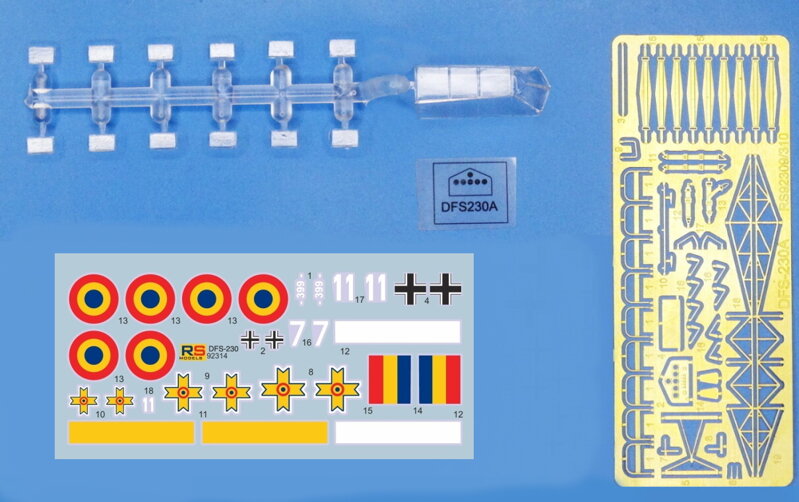
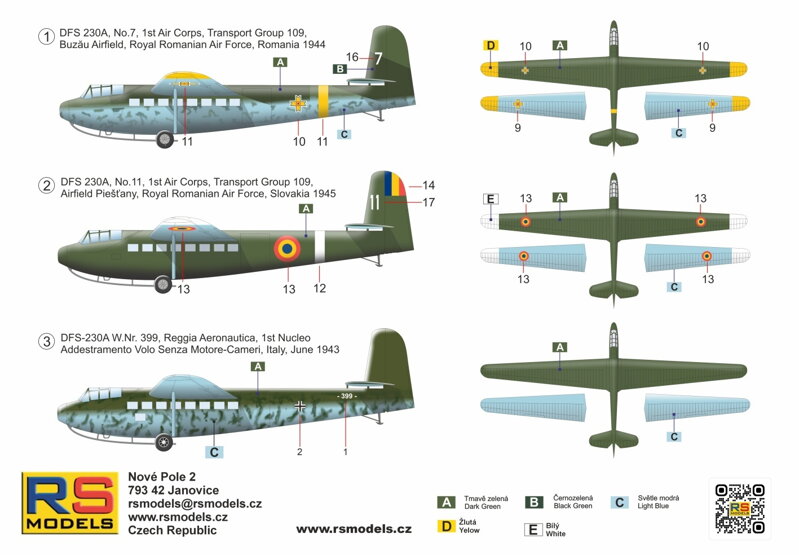
3 decal variants :
1. DFS 230A, No.7, 1st Air Corps, Transport Group 109, Buzău Airfield, Royal Romanian Air Force, Romania 1944
2. DFS 230A, No.11, 1st Air Corps, Transport Group 109, Airfield Piešťany, Royal Romanian Air Force, Slovakia 1945
3. DFS-230A W.Nr. 399, Reggia Aeronautica, 1st Nucleo Addestramento Volo Senza Motore-Cameri, Italy, June 1943
It played significant roles in the operations at Fort Eben-Emael, Crete, North Africa and in the rescue of Benito Mussolini and Assault on Tito's. However, it was used chiefly in supplying encircled forces on the Eastern Front such as supplying the Demyansk Pocket, the Kholm Pocket, Stalingrad, and the defenders of Festung Budapest . Although production ceased in 1943, it was used right up to the end of the war, for instance, supplying Berlin and Breslau until May 1945.