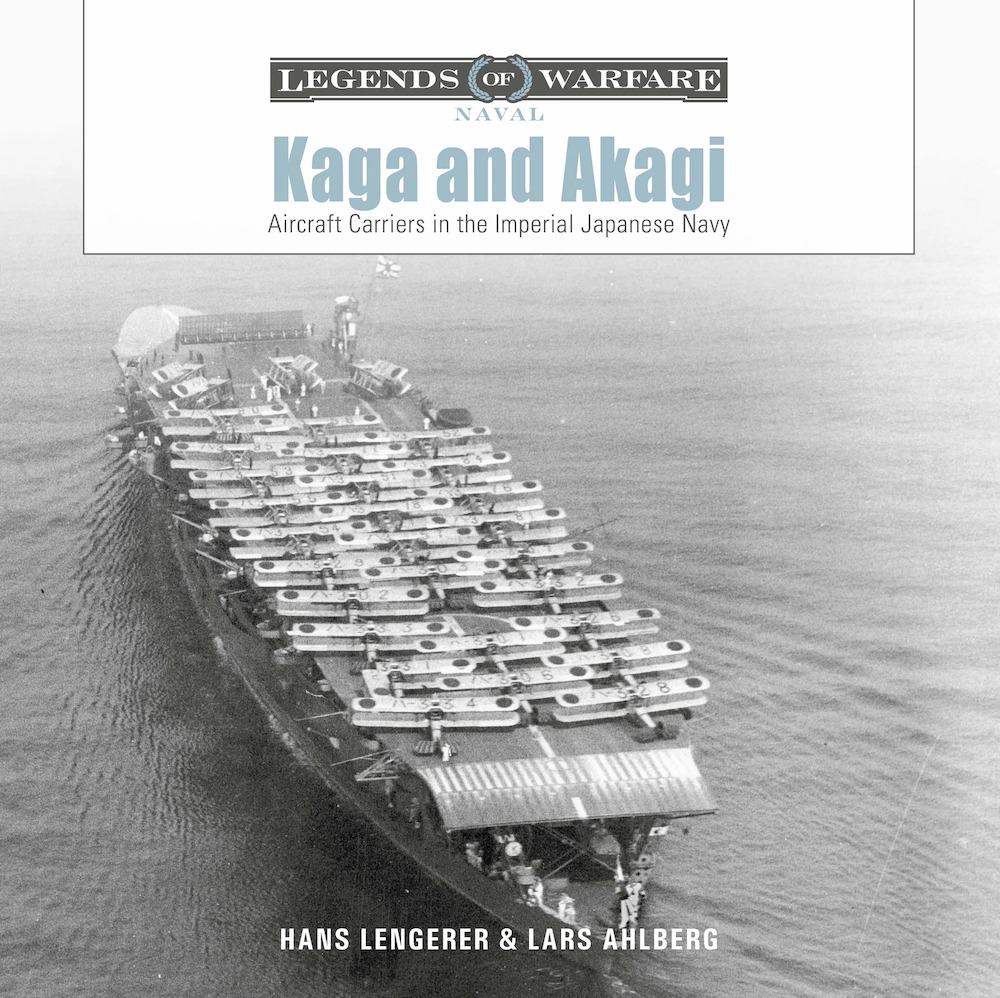
Kaga and Akagi Aircraft Carriers in the Imperial Japanese Navy
Product code 9780764368936
Series Legends of Naval Warfare
Publisher/Brand Schiffer
Author Hans Lengerer and Lars Ahlberg
Format 22 x 22 cm
No. Pages 128
Version Hard cover
Language English
Category Aviationbooks
Subcategory Military Aviation Books » Far East
Availability only 1 remaining
This product was added to our database on Saturday 3 January 2026.
Your reliable Aviation Book Source since 1989
Also in this series:
| Product | Publisher/Brand | Series/scale | Price € | ||
|---|---|---|---|---|---|
![]() | USS Hornet (CV-8): From the Doolittle Raid and Midway to Santa Cruz | Schiffer | Legends of Naval Warfare | € 21.06 | |
![]() | USS Intrepid (CV-11/CVA-11/CVS-11): From World War II, | Schiffer | Legends of Naval Warfare | € 27.48 | |
![]() | USS Nimitz (CVN-68): America's Supercarrier: 1975 to the Present | Schiffer | Legends of Naval Warfare | € 21.06 | |
![]() | USS Saratoga (CV-3) : From the 1920s–30s and WWII Combat to Operation Crossroads | Schiffer | Legends of Naval Warfare | € 31.15 | |
![]() | USS Yorktown (CV-10) Essex-Class Carrier in WWII, | Schiffer | Legends of Naval Warfare | € 33.90 |
A pictorial guide to Akagi and Kaga, two early Japanese aircraft carriers that were sunk at the Battle of Midway.
Akagi and Kaga were the second and third aircraft carriers to enter service with the Imperial Japanese Navy. Akagi was initially laid down as a battle cruiser, and Kaga as a battleship; both hulls were converted into aircraft carriers during the 1920s. The two ships played key roles in most of the early engagements of the Pacific War, and both were sunk at the Battle of Midway.
This is the illustrated history of both ships, including a historical synopsis, full technical description, and more than 100 photographs and diagrams. Naval historians Lars Ahlberg and Hans Lengerer have established themselves as experts on and specialists in the warships of the Imperial Japanese Navy during WWII. Their work is differentiated by being primarily driven by the utilization of Japanese-language primary source material.


