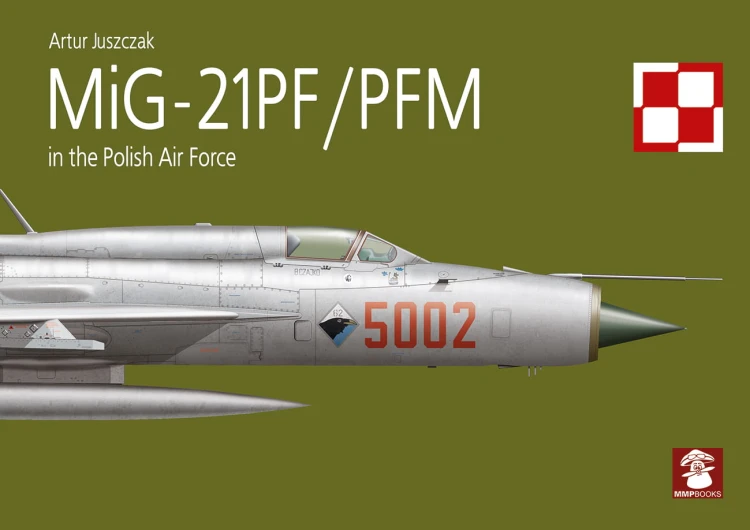
MiG-21PF / PFM in the Polish Air Force
Product code 9788368377279
Series Profile 9
Publisher/Brand Stratus
Author Artur Juszczak
Format A4 Landscape
No. Pages 36
Version Soft cover
Language Polish-English
Category Aviationbooks
Subcategory Military Aviation Books » Rest of Europe
Availability only 3 remaining
This product was added to our database on Thursday 27 August 2026.
Your reliable Aviation Book Source since 1989
Also in this series:
| Product | Publisher/Brand | Series/scale | Price € | ||
|---|---|---|---|---|---|
 | MiG-21Bis in the Polish Air Force | Stratus | Profile 7 | € 13.72 | |
 | PWS Training Aircraft | Stratus | Profile 7 | € 13.72 |
Over 60 full-colour profiles of MiG-21PF and MiG-21PFM aircraft operated in the Polish Air Force.
This publication by Artur Juszczak is a specialist study devoted to the MiG-21PF and MiG-21PFM in Polish military aviation service. The book has a documentary and reference character and is based on a detailed analysis of operational history, markings, and changes in the appearance of these aircraft throughout different periods of their service.
Already in the introduction, the author outlines the development of both MiG-21 variants. He notes that the MiG-21PF was the first representative of the second generation of the family, equipped, among other features, with the R-11F2-300 engine, the CD-30T radar sight, and the capability to carry RS-2US air-to-air guided missiles. The PFM version represented a further development of the design, introducing, among other changes, the KM-1 ejection seat, a redesigned cockpit canopy, an enlarged vertical fin, and new wings fitted with a boundary-layer blowing system, which improved take-off performance.
Bilingual publication.
One of the most important elements of the book is a detailed study of aircraft finishes and markings, including:
-
factory finish (natural aluminium with a clear lacquer coating),
-
overhaul finish (clear lacquer with aluminium powder),
-
placement of national markings in different periods (including the removal of fuselage markings in the 1970s),
-
rules of tactical numbering and its relationship to factory serial numbers,
-
evolution of unit badges and individual markings.
The author also highlights such details as visible stencil bridges in side numbers and changes in the application of markings, which are of particular importance for historical research and scale modelling.