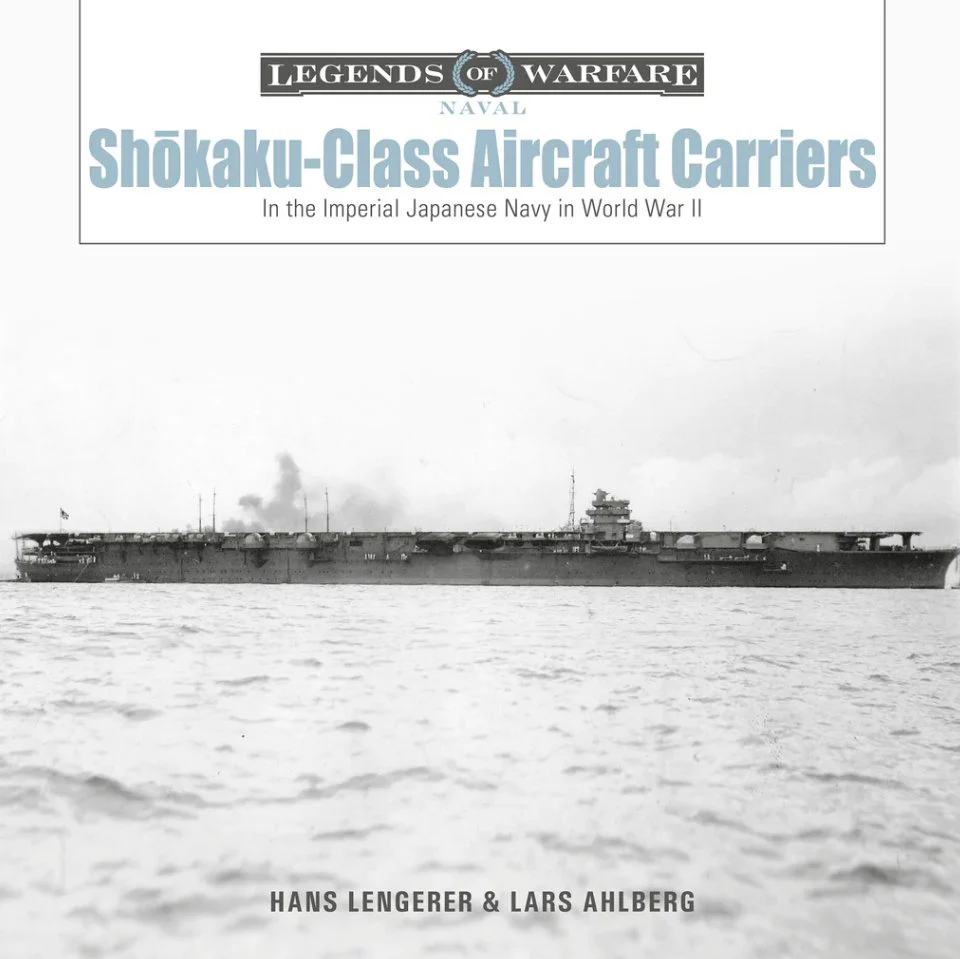
Shokaku-Class Aircraft Carriers In the Imperial Japanese Navy during World War II
Product code 9780764366512
Carrier
Series Legends of Naval Warfare
Publisher/Brand Schiffer
Author Hans Lengerer and Lars Ahlberg
Format 22 x 22 cm
No. Pages 128
Version Hard cover
Language English
Category Aviationbooks
Subcategory Military Aviation Books » Far East
Availability In stock
This product was added to our database on Tuesday 26 May 2026.
Your reliable Aviation Book Source since 1989
Also in this series:
| Product | Publisher/Brand | Series/scale | Price € | ||
|---|---|---|---|---|---|
 | Kaga and Akagi Aircraft Carriers in the Imperial Japanese NavyTemporarily Out of Stock. | Schiffer | Legends of Naval Warfare | € 33.90 | |
 | USS Hornet (CV-8): From the Doolittle Raid and Midway to Santa CruzTemporarily Out of Stock. | Schiffer | Legends of Naval Warfare | € 21.06 | |
 | USS Intrepid (CV-11/CVA-11/CVS-11): From World War II, | Schiffer | Legends of Naval Warfare | € 27.48 | |
 | USS Nimitz (CVN-68): America's Supercarrier: 1975 to the Present | Schiffer | Legends of Naval Warfare | € 21.06 | |
 | USS Saratoga (CV-3) : From the 1920s–30s and WWII Combat to Operation Crossroads | Schiffer | Legends of Naval Warfare | € 31.15 | |
 | USS Yorktown (CV-10) Essex-Class Carrier in WWII, | Schiffer | Legends of Naval Warfare | € 41.24 |
The aircraft carriers of the Shōkaku class are generally regarded as being the most-successful carriers designed by the Imperial Japanese Navy. They became operational just prior to the Pearl Harbor attack in December 1941, and their combat records are impressive. Compared with the preceding aircraft carrier designs, they represented a great design leap, combining excellent striking power with good protection. Even by the US Navy these ships were rated highly. During the Pacific War the two ships of the class participated in all carrier battles with the exception of Midway, Shōkaku being lost in the Battle of the Philippine Sea and Zuikaku off Cape Engaño (Battle of Leyte Gulf) in 1944. This is the history of their design and construction, and it relies heavily on Japanese source material and includes numerous photos and drawings.