Douglas F4D/F6 Skyray
Product code ws-117
Douglas
Series Warpaint Series No 117
Publisher/Brand Hall Park
Author Tony Buttler
Format a4
No. Pages 125
Version Soft cover
Language English
Category Aviationbooks
Subcategory US » US Jet Aircraft
Availability only 4 remaining
This product was added to our database on Monday 10 December 2018.
Your reliable Aviation Book Source since 1989
Also in this series:
| Product | Publisher/Brand | Series/scale | Price € | ||
|---|---|---|---|---|---|
 | Avro Anson MK1-22 | Hall Park | Warpaint Series No 53 | € 16.47 | |
 | De Havilland Vampire (REISSUE!) | Hall Park | Warpaint Series No 27 | € 20.14 | |
 | Folland Gnat & HAL Ajeet | Hall Park | Warpaint Series No 67 | € 13.72 | |
 | Grumman F14 Tomcat | Hall Park | Warpaint Series No 126 | € 27.48 | |
 | Hawker Sea Hawk | Hall Park | Warpaint Series No 29 | € 14.63 | |
 | Hawker Siddeley HS748 & Andover | Hall Park | Warpaint Series No 151 | € 20.14 | |
 | Heinkel He177 Greif | Hall Park | Warpaint Series No 33 | € 13.72 | |
 | McDonnell Douglas F4K and F4M Phantom | Hall Park | Warpaint Series No 31 | € 17.39 | |
 | Mil Mi4 | Hall Park | Warpaint Series No 144 | € 21.06 | |
 | Republic F105 Thunderchief | Hall Park | Warpaint Series No 38 | € 15.55 |
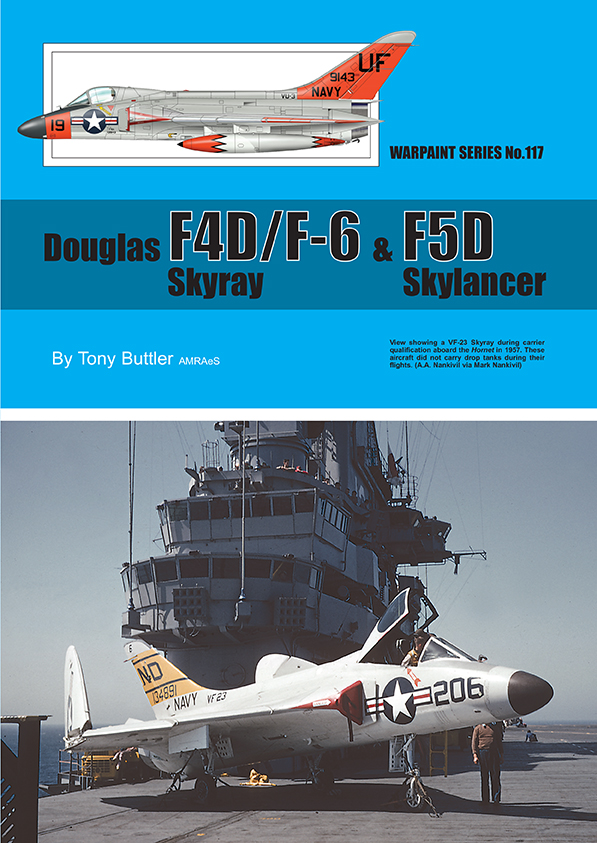
The Douglas F4D Skyray (always known as the 'Ford' because of its designation) was intended to be the US Navy's first supersonic fighter, though in fact it was really a transonic aircraft. A very handsome machine it had a relatively short career but equipped quite a number of units both with the Navy and the US Marines. It was flawed and fell short of being a true all-weather fighter, but it had excellent manoeuvrability and an impressive rate of climb and it provided many pilots with their first experience of jet aircraft. The altogether sleeker F5D Skylancer was a true supersonic successor and provided a considerable advance over the Skyray, but it fell victim to cost cutting and only a few examples were completed, some of which were used for research. This book is written by Tony Buttler and is superbly illustrated by Richard J.Caruana.