Curtiss Tomahawk Iib
Product code 70095
Curtiss
Provisional price
subject to change
Scale 1 : 72
Publisher/Brand Arma Hobby
Category Scale Modelling Kits
Subcategory Scale Modelling Kits
Availability Expected.
Click here to be notified when this product becomes available
This product was added to our database on Friday 9 October 2026.
Your reliable Aircraft Modelling Source since 1989
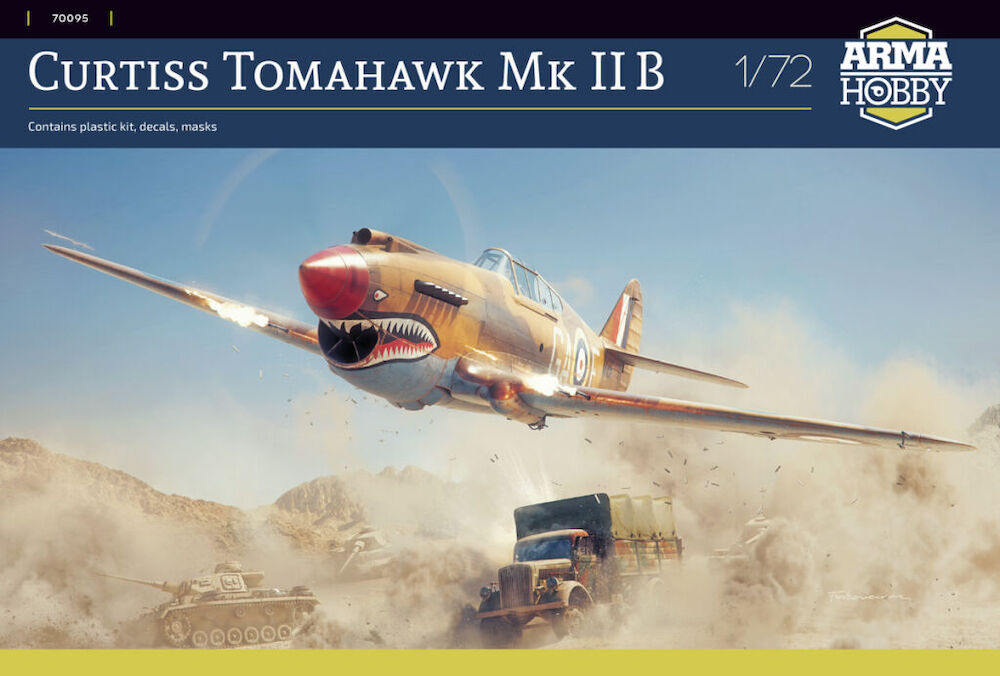
Curtiss Tomahawk Mk IIB was the British version of the Hawk 81A-3, corresponding to the American P-40C. In 1941, these aircraft arrived in increasing numbers in the Middle East, serving with RAF and Commonwealth squadrons during the intense fighting over North Africa.
Tomahawks became particularly associated with No. 112 Squadron RAF. It was on the unit's aircraft that the spectacular shark mouths appeared, later becoming one of the most recognizable markings associated with the entire P-40 family and inspiring similar markings on the famous Flying Tigers in China.
Kit contents
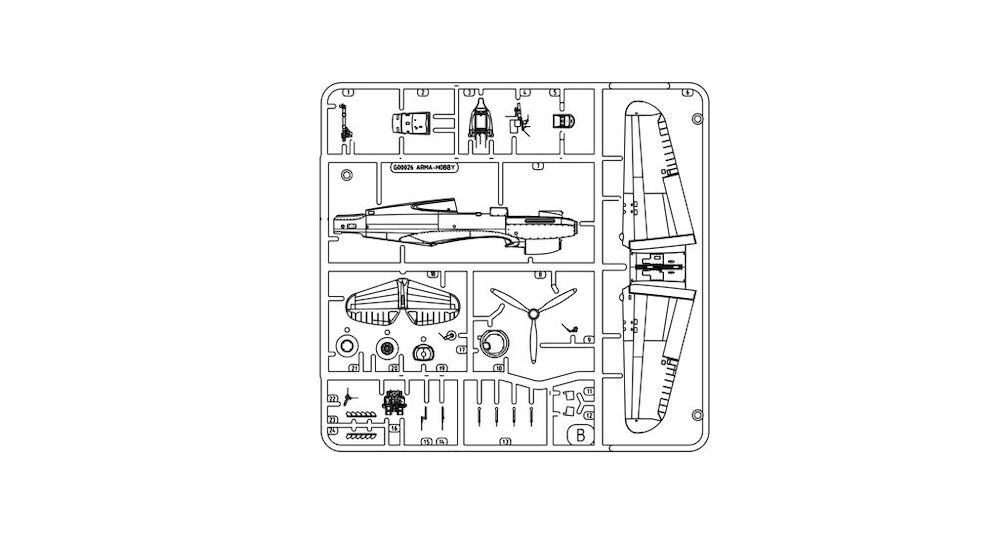
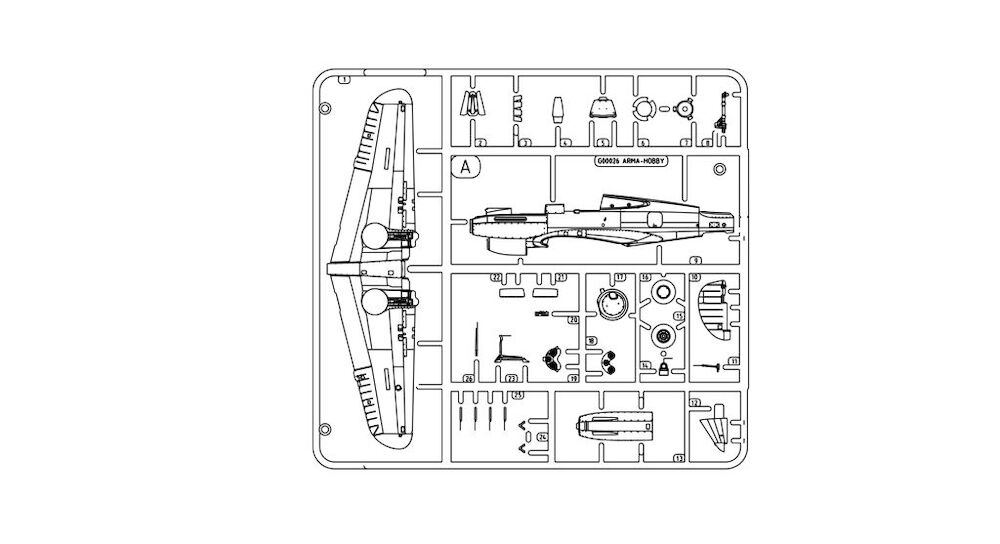
- plastic parts on one grey sprue,
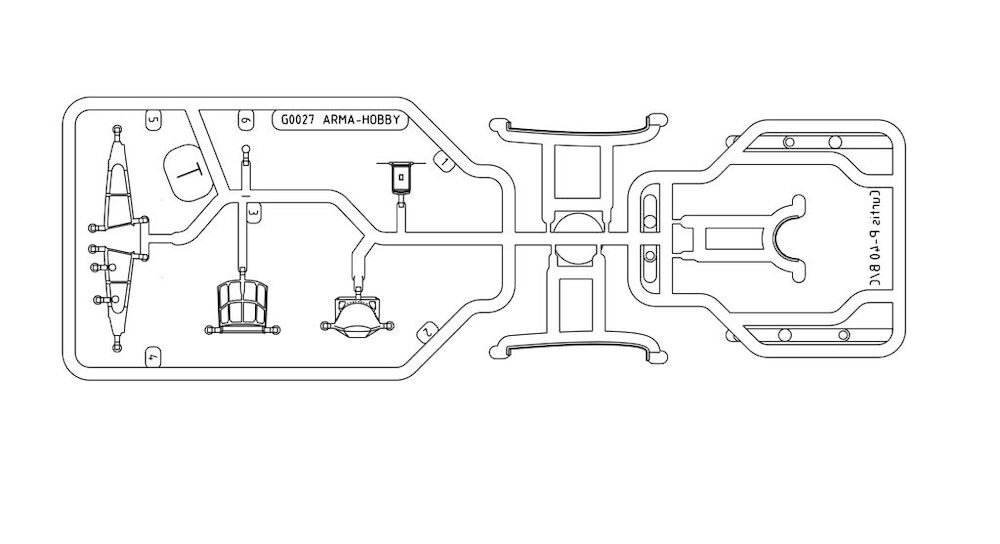
- clear parts and Arma Jig on one sprue,
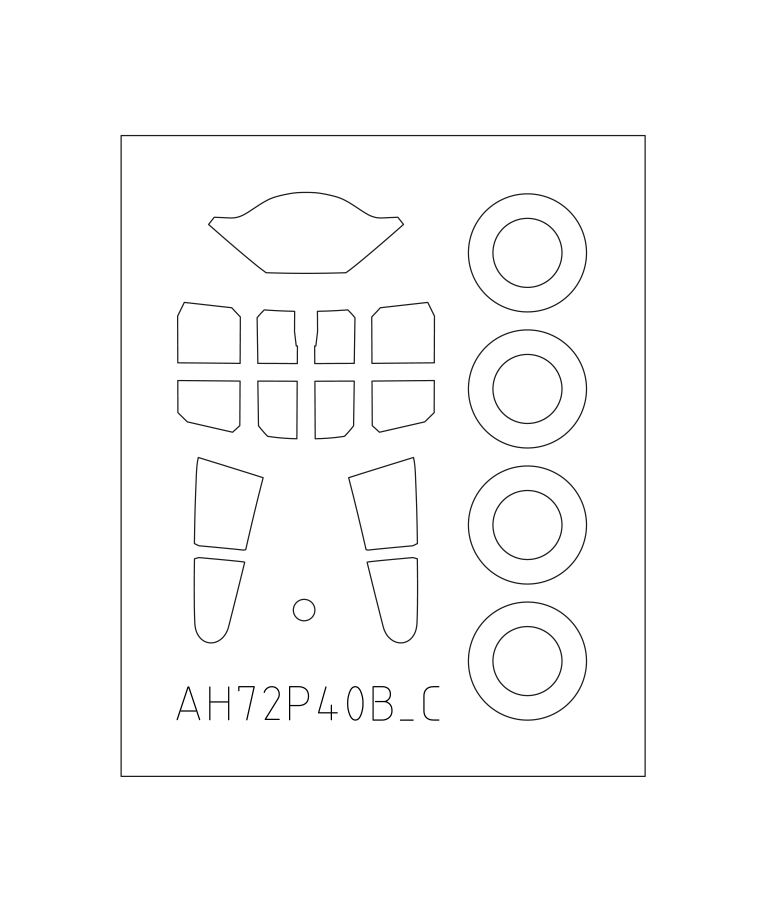
- masks for the canopy and wheels,
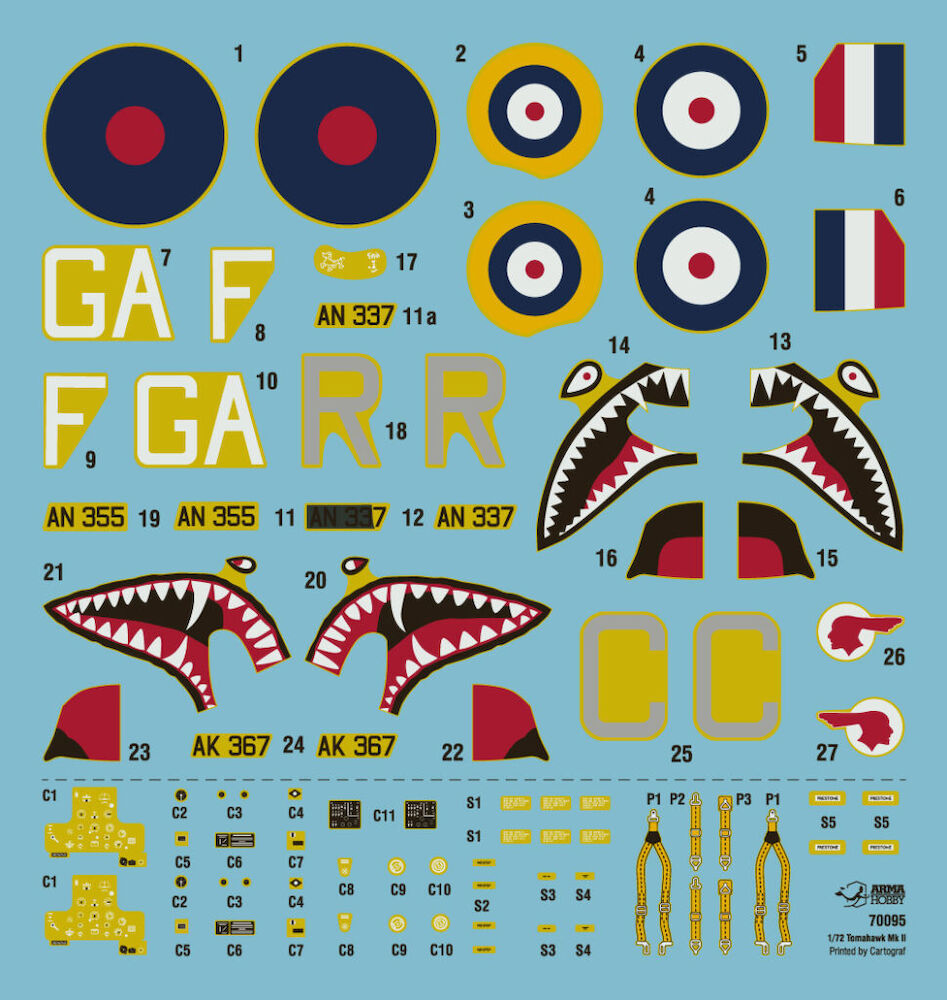
- Cartograf decals with three marking options,
- code for downloading 3D-printable files for exhaust stacks, machine-gun barrels, gunsights and a pilot's seat with British harness.
Planned shipping: third week of October 2026.
Marking options
AN337/GA-F – Neville Duke's Tomahawk
Curtiss Tomahawk Mk IIB, AN337/GA-F, No. 112 Squadron RAF (Royal Air Force), P/O Neville Frederick Duke, LG.122, Egypt, December 1941.
AN337 was the second Tomahawk coded GA-F flown by Neville Duke during the intense fighting associated with Operation “Crusader”. Unlike the earlier AK367, this aircraft already wore a desert camouflage scheme. Its most distinctive markings were the spectacular No. 112 Squadron shark mouth and the large white GA-F codes.
Duke was one of the pilots who began building their wartime reputation flying Tomahawks. In December 1941, he flew AN337 in combat against German and Italian aircraft until the aircraft was damaged in action and lost following a forced landing.
N355/R “Snifter” – No. 3 Squadron RAAF
Curtiss Tomahawk Mk IIB, AN355/R “Snifter”, No. 3 Squadron RAAF (Royal Australian Air Force), LG.102 Sidi Heneish, Egypt, September–October 1941.
The aircraft was flown, among others, by F/L Alan C. Rawlinson and F/O Lindsay E. Knowles. AN355 retained the Temperate Land Scheme of Dark Earth and Dark Green, applied at the American factory as an equivalent of the British camouflage scheme. Small individual markings on the engine cowling and the large white letter “R” gave the aircraft its distinctive appearance.
AN355 was shot down on 12 October 1941 in the Bir Sheferzen area. Its pilot, Sgt Thomas D. Parker, was killed.
AK367/C “Pontiac” – No. 112 Squadron RAF
Curtiss Tomahawk Mk IIB, AK367/C “Pontiac”, No. 112 Squadron RAF (Royal Air Force), F/O Douglas G.H. McDonald, LG.102 Sidi Heneish, Egypt, September–October 1941.
AK367 retained its factory-applied Temperate Land Scheme of Dark Earth and Dark Green, but already carried the characteristic shark mouth of No. 112 Squadron. Its shape differed from later versions of the marking, showing how quickly the famous motif evolved. Another individual marking was the Native American head "Pontiac" emblem on the fuselage.
Tomahawk Mk IIB over the Desert
The Tomahawk Mk IIB was the British version of the Curtiss Hawk 81A-3, closely related to the American P-40C. Powered by the Allison V-1710 engine, it was armed with two .50-calibre machine guns in the fuselage and four .303-calibre Brownings in the wings. Improved self-sealing fuel tanks made it better suited to combat than the earlier Tomahawk variants. The Mk IIB became by far the most numerous Tomahawk in British service.
Tomahawks began reaching the Middle East in quantity in 1941. They equipped several RAF and Commonwealth squadrons, replacing older fighters including Gladiators and Hurricanes. No. 3 Squadron RAAF began converting from Hurricanes in May, while No. 112 Squadron RAF received its Tomahawks in June.
The Tomahawk was not an ideal high-altitude interceptor, but over the Western Desert it proved to be a rugged and effective fighter. During the hard fighting of 1941, culminating in Operation Crusader, Tomahawk squadrons fought German and Italian aircraft at low and medium altitudes. Among the pilots who made their names on the type was Neville Duke of No. 112 Squadron. Our AN337, GA-F, represents the second Tomahawk to carry Duke's personal code.
The aircraft arrived from America in the Temperate Land Scheme, most probably painted at the Curtiss factory with DuPont paints matched to British colour standards. In the Middle East many were modified to the more suitable Desert Scheme, usually by overpainting the original Dark Green areas with a lighter brown or Middle Stone. This resulted in considerable variation in colours and finish between individual aircraft. Contemporary photographs show this process clearly on Tomahawks of No. 3 Squadron RAAF.
It was No. 112 Squadron that gave the Tomahawk its most famous identity. In the summer of 1941 its aircraft began appearing with spectacular shark mouths painted around the deep radiator intake. The marking may have been inspired by the shark-mouthed Bf 110s of II./ZG 76 and quickly became the squadron's trademark. The idea was soon adopted by the American Volunteer Group in China, the famous Flying Tigers, whose own shark-mouthed P-40s made the motif an enduring symbol of the entire P-40 family.
By the end of 1941 the Tomahawk was already beginning to give way to the improved Kittyhawk, but in a few intense months of desert fighting it had established the reputation that would follow the P-40 throughout the war.