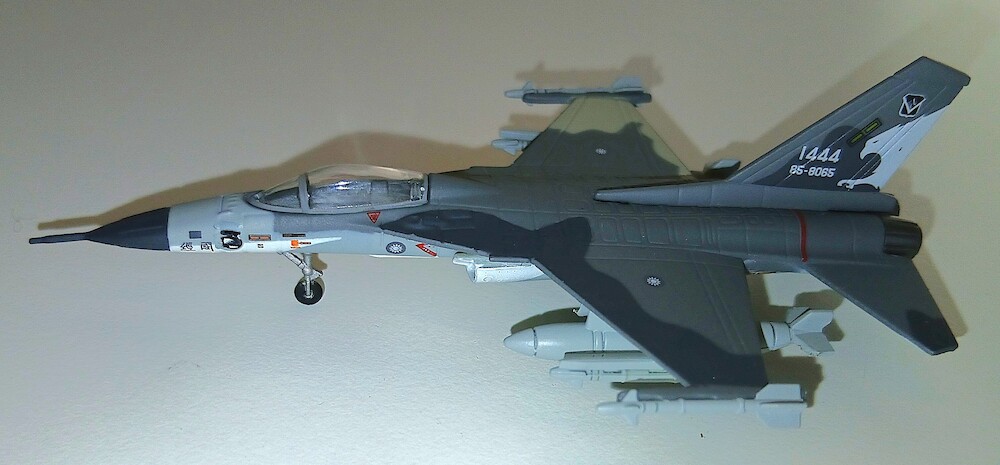
IDF FCK1CA ROCAF 1st Fighter Squadron, 1st Tactical Fighter Wing 1444/85-8065
Product code BW144004
AIDC
IDF F-CK-1 Ching-Kuo
Scale 1 : 144
Publisher/Brand Bless Wing
Format approx W 6.3 x L 9.9 x H 3.1 cm
Version Diecast metal construction with some plastic components. Realistic panel lines, antennas, access panels and surface details. Pad printed markings and placards that won't fade or peel like decals., without stand, with landing gear
Category Aircraft Scale Models
Subcategory 1:144 Aircraft Scale Models » 1:144 Bless Wing
Availability only 1 remaining
This product was added to our database on Saturday 7 february 2026.
Your reliable Aircraft Model Source since 1989
-
Improved cockpit with "full" size pilot figure
-
Corrected canopy design
-
Detailed landing gears with landing lights
-
All-new weapons set featuring Taiwan self-developed missile systems
-
Wan Chien JASSM
-
Air launched Hsiung Feng III anti-ship missile "PLAN Carrier killer"
-
Sky sword I air-to-air missile
-
New display stand with adjustable viewing angles
-
"White Eagle" scheme
-
Air launched Hsiung Feng III anti-ship missile "PLAN Carrier killer" * 2
-
Sky sword missile * 2 (2 wing tip "fixed")
-
Centerline fuel tank * 1
1st Fighter Squadron, 1st Tactical Fighter Wing
The wing was formed in Hankou on September 15, 1945 and was previously known as the Air
Force 1st Wing Command. This was the reorganization of the previous Chinese-American
Composite Wing, and was directly subordinated to the Aviation Committee. In Autumn 1945,
The Air Force changed into the military region system and the code of the 1st wing ceased to
exist. The Air Force was re-grouped in Taiwan on December 1, 1952 and the unit has resumed
the code as the 1st Wing bearing the full title of “Air Force 1st Combat Bomber Wing”. The
wing was ordered to station at Tainan in 1953, and started to replace with the F-84G fighters
on June 1 of the same year. The “Thunder Tiger” Flying Team was formed on August 14, 1954.
The F-86F Sabre started to deploy on September 4, 1958. The wing was ordered to rename as
the “Air Force 1st Tactical Wing” on June 16, 1960, and started to replace with the F-5A/B
fighters on March 24, 1968. On December 16, 1970, the 71st Air Support Control Squadron
was introduced with the takeover of the O-1G plane. The wing start to replace with the F-
5E/F fighters on December 17, 1974, and was renamed as the “Air Force 443rd Tactical Wing”
on August 16, 1976. The 71st Air Support Control Squadron phased out the O-1G and took
over the A-CH-1 Chung Hsing Fighters, and renamed as the 71st Air Control and Attack
Squadron. The 72nd Air Control and Combat Squadron was put under its command on May 1,
1987. In consideration of the heavy burden of the wing in combat exercise drill, the Air Force
General Command Headquarters assigned the “Thunder Tiger” team to the Air Force
Academy on May 12, 1989. The 72nd Squadron was merged into the 71st Squadron on August
1, 1991, while the latter was officially dissolved on January 1, 1996 under the new military
deployment of the air force in conformity to the “Streamlining Program”. In March 1997, the
IDF “Ching Kuo” fighter was assigned to the wing in accordance with the “Planning of the
Replacement of Equipment for the Buildup of the New Generation of The Air Force” in March
1997. Replacement of the new fighter was completed with the formation of the 1st and the
3rd Groups on January 7, 1999. The ceremony of the formation of the 9th Group and the Wing
was held on July 14, 2000 to execute the order of the defense of the air space over the
Taiwan Straits through combat, exercise drill, and training missions. For enhancing the
performance of the IDF, the wing unfolded the “IDF MLU Development Project” at AIDC in
Taichung, with delivery on May 5, 2011. The wing then performed various types of combat,
exercise drills and training missions for safeguarding the security of the air space over the
Taiwan Straits.
Location:Tainan Air Base
Wan Chien Joint Standoff Weapon (Wan Chien Missile)
The Wan Chien Joint Standoff Weapen is an air to ground cruise missile developed and produced by
the National Chung-Shan Institute of Science and Technology (NCSIST) of Taiwan.
It partly resembles the AGM-154 Joint Standoff Weapon and the Storm Shadow. Serial production was
expected to start in 2015. Full operational capability was declared in 2018. It is functional in both a
ground strike role and a naval strike role. The codename for the development and initial production of
the Wan Chien was "Project God’s Axe". After the completion of initial production NCSIST began
working on a long range variant with a 400km range.
The Wan Chien entered service in 2011. The primary launch platform is the AIDC F-CK-1.
In 2022 annual production was approximately 50 missiles a year. Production was expected to end in
2024 but in 2023 funds were allocated to extend production of the improved version through 2028.
Hsiung Feng III Missile (Air Launched Version)
The Hsiung Feng III (HF-3/Brave Wing III) is a medium range supersonic missile with capabilities to
destroy both land based targets and naval targets developed and produced by the National Chung-
Shan Institute of Science and Technology (NCSIST) of Taiwan.
Initial prototype versions of the missile used the design of an integrated rocket ramjet to
achieve supersonic speeds. It uses a solid fuel main booster with two side-by-side solid-propellant
jettisonable strap-on rocket boosters for initial acceleration and a liquid-fueled ramjet for sustained
cruise. It also employs electronic counter-countermeasures (ECCM) capabilities allowing it to
penetrate an enemy ship's defenses.
The missile is cylindrical in shape and composed of three sections, namely guidance and control,
warhead, and propulsion. The body has four inlet ducts and four clipped delta control surfaces. It used
the inertial navigation system (INS) during mid-course navigation phase and active radar seeker at
terminal guidance phase. The air intake design arrangement was reported to have been optimized for
evasive maneuvering at terminal sea-skimming altitudes. The missile is designed to be capable of way-
pointing and can be programmed to fly offset attack axes to saturate defenses. It is also capable of
high-G lateral terminal "random weaving" maneuvers to evade close-in defenses.
It also features an armor-piercing warhead which generates tremendous destruction after hitting the
target. The warhead is equipped with self-forging fragments and in the 225 kg (500 lb) weight class. It
has a conventional warhead that is triggered by a smart fuze which directs most of the energy
downwards, inside the target ship's hull.
The missile is believed to have an operating range of over 100 km (62 mi; 54 nmi) and a extended
range version with a possible maximum range of over 400 km (250 mi; 220 nmi) . It can be deployed
on ships and mobile trailers. The instructions for missile launch can be issued by a command and
control system for different platforms and different paths leading to saturation of a ship's defense
system.
The development of an air-launched variant of the HF-3, dubbed the Hsiung Chih, was disclosed in
2022. The air launched variant in expected to be significantly lighter and to use the F-CK-1 as a launch
platform. The air launched variant was spotted undergoing testing in 2025