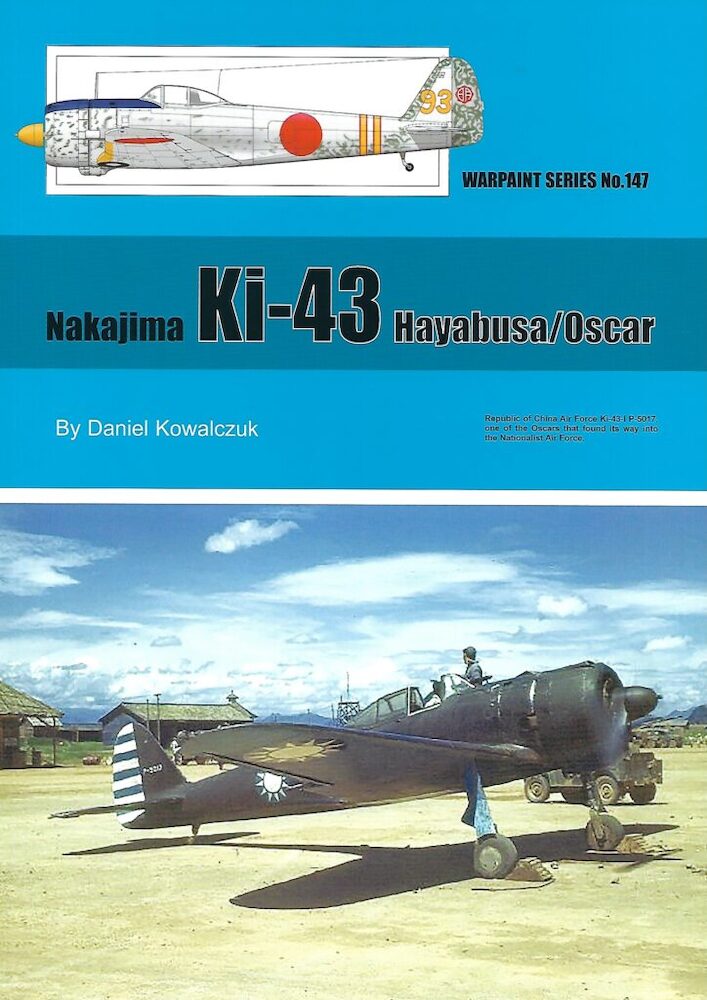
Nakajima Ki43 Hayabusa / Oscar
Product code WS-147
Nakajima
Series Warpaint Series No 147
Publisher/Brand Hall Park
Author Daniel Kowalczuk
Format a4
No. Pages 72
Version Soft cover
Language English
Category Aviationbooks
Subcategory WW2 » WW2 Japanese Aircraft
Availability only 2 remaining
This product was added to our database on Monday 28 April 2025.
Your reliable Aviation Book Source since 1989
Also in this series:
| Product | Publisher/Brand | Series/scale | Price € | ||
|---|---|---|---|---|---|
 | Albatros D.I - D.III | Hall Park | Warpaint Series No 122 | € 16.47 | |
 | Avro Vulcan B1, | Hall Park | Warpaint Series No 30 | € 14.63 | |
 | Bristol Beaufort | Hall Park | Warpaint Series No 50 | € 16.47 | |
 | Bristol Scout | Hall Park | Warpaint Series No 128 | € 16.47 | |
 | Convair (Consolidated Vultee) B-36 'Peacemaker' | Hall Park | Warpaint Series No 102 | € 17.39 | |
 | Dornier Do217 | Hall Park | Warpaint Series No 24 | € 14.63 | |
 | Fairey Fulmar | Hall Park | Warpaint Series No 41 | € 15.55 | |
 | Handley Page Hampden and Hereford | Hall Park | Warpaint Series No 57 | € 15.55 | |
 | Martin Mariner and Marlin | Hall Park | Warpaint Series No 108 | € 16.47 | |
 | Westland Wessex | Hall Park | Warpaint Series No 65 | € 16.47 |
One of the great unsung fighters of the Imperial Japanese Army Air Force was Nakajima's Ki-43 Hayabusa (Peregrine Falcon). Codenamed 'Oscar' by the Allies, the aircraft was frequently mistaken for the Navy's A6M2 Zero by those encountering it in combat, to the extent that it was widely referred to by its adversaries as the 'Army 0'.
Highly regarded in Japan, where it was much more widely recognised than the Zero, the Ki-43 was the only Japanese fighter from the Pacific War to see active service with other air forces, being supplied to both Thailand and Manchukuo by the Japanese, but also seeing use by France in Indochina, and by the air forces of Indonesia, the Republic of China, and North Korea, who pressed abandoned but airworthy airframes into service, some of which survived into the early 1950s.
Author Daniel Kowalczuk has compiled a compelling narrative that puts the aircraft in context, describes its development and active service history in detail, and explains how it came to be so widely regarded by the Japanese-so much so that it is the aircraft of choice for producers of Anime rather than its better known contemporary