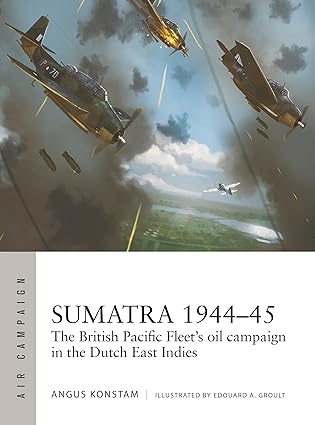
Sumatra 1944-1945, The British Pacific Fleets oil campaign in the Dutch East Indies
Product code 9781472862419
Series Air Campaign 49
Publisher/Brand Osprey
Author Angnus Kohnstam
Format a5
No. Pages 96
Version Soft cover
Language English
Category Aviationbooks
Subcategory WW2 » WW2 Pacific
Availability In stock
This product was added to our database on Wednesday 27 November 2024.
Your reliable Aviation Book Source since 1989
Also in this series:


The first history of how the aircraft of the British Pacific Fleet shattered Japanese oilfields in Sumatra, starving Japan of oil and proving how Anglo-American navies could fight together.
With the war in Europe in its final stages, by 1944 the Royal Navy was able to put together a major force to join the campaign against Japan. The British Pacific Fleet was arguably the most powerful fleet the Royal Navy has ever sent into action.
In this book, renowned naval historian Angus Konstam explores how the first target of British naval power in the Pacific would be the strategically vital oil fields in Japanese-occupied Sumatra, part of the Dutch East Indies. Between April 1944 and January 1945, the task force struck oil fields and production centres, Japanese airfields, naval facilities and troop concentrations. Initially working alongside US Navy carriers, and learning their ruthlessly effective fast carrier doctrine, the British would end the Sumatra campaign with a powerful fleet of ten carriers of their own.
Packed with dramatic artwork, maps, 3D diagrams and archive photos, this is the first history of the Sumatra raids, a prime example of how naval air power could achieve key strategic ends. They also proved that the Allied navies could fight successfully alongside one another – paving the way for the BPF’s participation in the capture of Okinawa.