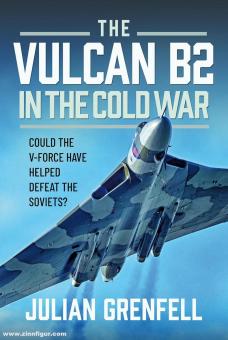
The Vulcan B2 in the Cold War. Could the V force helped defeat the Soviets
Product code 9781036144845
Publisher/Brand Pen & Sword
Author Julian Grenfell
Format A4
No. Pages 245
Version Hard Back
Language English
Category Aviationbooks
Subcategory WW2 US » WW2 US Aircraft
Availability Temporarily Out of Stock.
Click here to be notified when this product becomes available again
This product was added to our database on Wednesday 4 November 2026.
Your reliable Aviation Book Source since 1989
Many people who lived through the Cold War wondered about the nuclear deterrent provided by the V-Force: If it had come to that, would it have served its purpose? This book, written by an avionics engineer with around 4,500 flying hours in Avro Vulcans, attempts to answer that question. The Vulcan B2 in the Cold War analyses the state of the air forces in the early years of the Cold War and examines the hot wars in Korea and Vietnam, as well as the early versions of the Soviet and Chinese air defence systems and their potential effectiveness against the RAF’s nuclear bomber fleet. Britain’s deterrent weapons had to survive a pre-emptive ballistic missile attack by the Soviet Union or be launched before such an attack. The early warning system gave Bomber Command headquarters approximately 3½ to 4½ minutes’ warning to get the V-Force airborne. The average time to get these aircraft airborne was an astonishing 1 minute and 53 seconds. The author explains the combat environment that the Vulcan had to fly into in order to drop its weapons. It had to be able to outmanoeuvre enemy fighter aircraft and evade detection by surface-to-air missile radar systems. Such factors were taken into account in the so-called probability of kill. The Vulcan’s effectiveness in evading Soviet defences was put to the test at several critical moments during the Cold War. One such event was the Cuban Missile Crisis of 1962. Another extremely important element of the Vulcan’s role was the type of weapons it carried and how they were delivered. All of this is discussed in this fascinating study of how the Vulcan, or more specifically the B2 variant, would have performed if the Cold War had turned hot