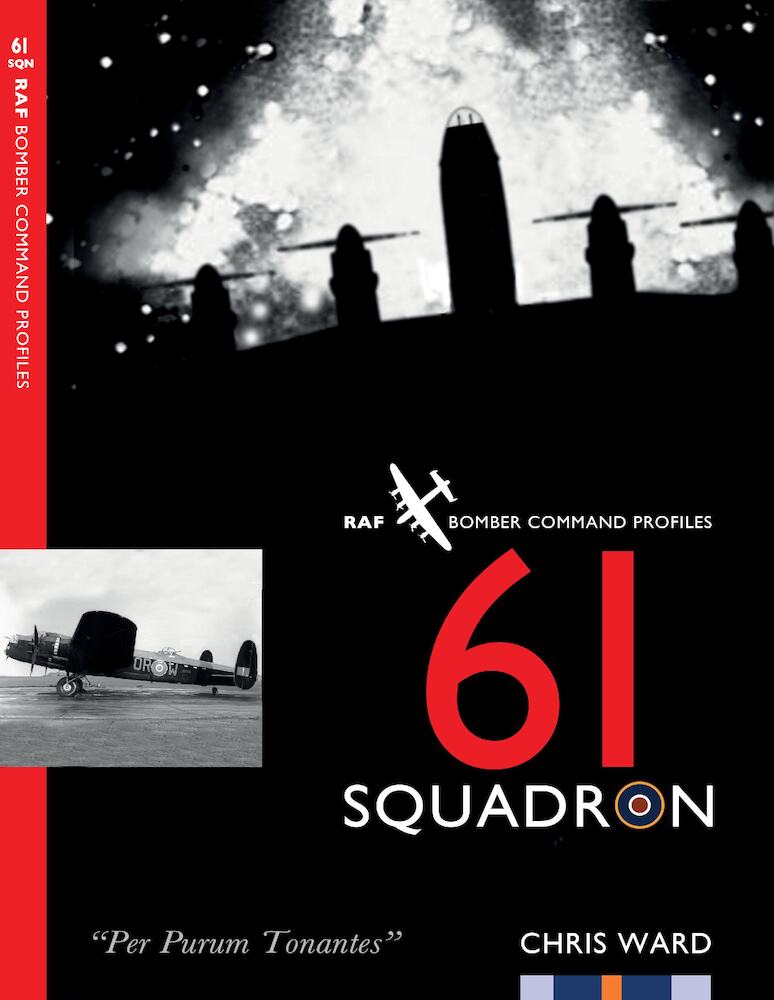
61 Squadron "Per Purum Tonantes"
Product code 9781915335470
Series RAF Bomber Command Profiles
Publisher/Brand Aviation books
Author Chris Ward
Format a4
No. Pages 450
Version Soft Cover
Language English
Category Aviationbooks
Subcategory WW2 UK » WW2 UK Units
Availability only 1 remaining
This product was added to our database on Thursday 17 july 2025.
Your reliable Aviation Book Source since 1989
Also in this series:
| Product | Publisher/Brand | Series/scale | Price € | ||
|---|---|---|---|---|---|
 | 12 Squadron "Leads the Field" | Aviation books | RAF Bomber Command Profiles | € 34.82 | |
 | 550 Squadron "Through Fire we Conquer" | Aviation books | RAF Bomber Command Profiles | € 26.56 | |
 | 576 Squadron "Seize the day" | Aviation books | RAF Bomber Command Profiles | € 27.48 | |
 | 90 Squadron | Aviation books | RAF Bomber Command Profiles | € 26.56 | |
 | No311(Czechoslovak) squadron in RAF Bomber Command 1940-1942 "Na Mnozstvi Nehled'te" | Aviation books | RAF Bomber Command Profiles | € 25.64 |
At the outbreak of the Second World War, 61 Squadron was one of six front-line squadrons serving in 5 Group Bomber Command and operating twin-engine Handley Page Hampdens. The squadron was stationed at Hemswell in Lincolnshire with 144 Squadron and was largely operationally inactive for the remainder of 1939 and during the first quarter of 1940 apart from leafleting sorties in February and an attack on a seaplane base in March.
It was only when Germany invaded Denmark and Norway in April that the squadron began to operate on a regular basis, against shipping and aerodromes in southern Norway and took part in the very first mining operation of the war. The squadron remained at the forefront of 5 Group operations but spent two short periods of detachment to Coastal Command in the summer of 1942 and distinguished itself during the very first convoy protection patrol by sinking a German U-Boot.
The squadron took part in all of the Command's major offensives, including the Ruhr campaign from March to July 1943, the Battle of Hamburg in July 1943, the Battle of Berlin (Winter Campaign) between August 1943 and March 1944, the pre-invasion assaults on railways and coastal defences, the anti-V-Weapon and oil campaigns in the summer of 1944 and tactical support for the ground forces. The squadron was present when 5 Group spearheaded attacks on Germany's oil industry from the autumn of 1944 through to the end of the bombing war and became the Command's "canal busters" during the same period. 61 Squadron conducted operational trials with the Hercules-powered Mk II Lancaster between October 1942 and March 1943 and ended the war having conducted Lancaster bombing operations than any other squadron.